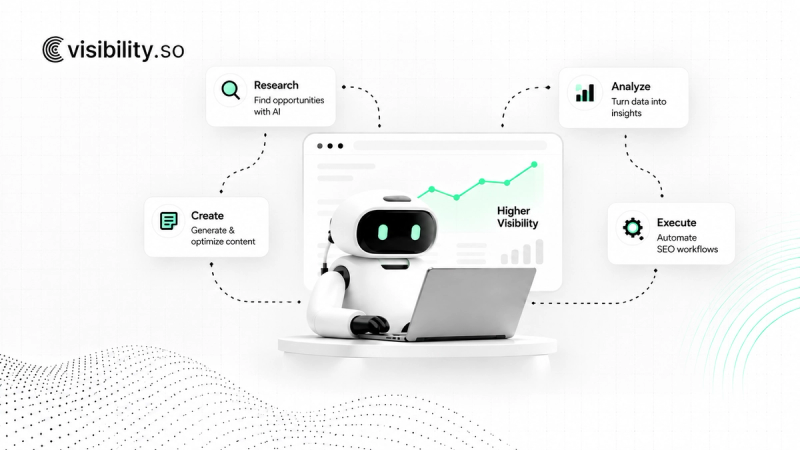
Search engine optimization changed how businesses got discovered online. Now, a new kind of optimization is emerging — one designed not for search engines, but for AI agents.
It’s called Agentic Engine Optimization (AEO), and it’s quickly becoming one of the most important concepts for any business with a digital presence.
What Is AEO?
AEO stands for Agentic Engine Optimization. Simply put, it’s the practice of making your website content, documentation, and APIs easy for AI agents to find, read, and use.
You may already be familiar with how ChatGPT, Claude, or Gemini answer questions by pulling information from the web. But AI isn’t just answering questions anymore — it’s taking action. AI coding agents, research tools, and autonomous assistants now browse websites, read documentation, and integrate APIs automatically, all without a human clicking a single button.
Consider what happens when a developer uses an AI coding tool to add a payment feature to their app. The AI agent doesn’t just write code — it reads your payment API documentation, figures out how the API works, and then writes code based on what it found. If your documentation is hard for the agent to read, the agent will either write broken code or skip your API in favor of a competitor’s.
AEO is about making sure your content works well for these AI systems — not just for human visitors.
How AI Agents Read the Web (And Why It’s Different)
To understand why AEO matters, you need to see the web the way an AI agent does.
When a human visits your documentation, they might spend several minutes navigating the site, clicking links, using a search bar, and reading at their own pace. They build understanding gradually. They scroll back up when they need to check something. Every action they take shows up in your analytics.
An AI agent does something very different. It makes one or two direct web requests, strips out all the HTML formatting, and reads your content as raw text. It doesn’t click buttons, doesn’t execute JavaScript, and doesn’t follow navigation menus. It processes everything at once — and it’s working with a limited amount of text it can hold in memory at one time (called a “context window”).
Think of it like this: a human developer might visit your docs seven times over a week, gradually learning your product. An AI agent gets one shot. It reads what it can find, and then acts on that information immediately. If the content is hard to parse or incomplete, the agent will either skip important parts or fill in the gaps on its own — which can lead to mistakes.
This creates real problems that most businesses aren’t even aware of:
- Your content might be invisible: If important information is hidden behind JavaScript, dropdown menus, or interactive demos, AI agents can’t see it. They’re reading raw text, not rendering a page.
- Your pages might be too long: If a single page contains more text than an AI can hold in memory, it will skip content or make up the parts it couldn’t read. This happens silently — no error message, no warning.
- You can’t see the traffic: AI agents bypass the analytics code on your website. You could be getting thousands of AI visits every week without a single one showing up in your dashboard.
- You might be accidentally blocking AI: The robots.txt file on your website tells web crawlers what they can and can’t access. It might be blocking AI agents without you realizing it.
The Five Core Problems AEO Solves
1. Discoverability
AI agents need a clear, simple path to find your content. If your site relies on navigation menus or JavaScript to show key pages, agents may never find them. The fix is to create plain-text indexes that point agents directly to what they need.
2. Readability
Content needs to be clean and easy for machines to process. Simple headings, plain language, tables, and clear code examples all help. Fancy layouts, callout boxes, and interactive elements don’t — agents ignore them or get confused by them.
3. Length
AI agents can only process a certain amount of text at once. Very long pages cause agents to skip content or guess at what they missed. Shorter, focused pages work much better. A good rule of thumb: keep individual pages under 20,000 to 25,000 words worth of tokens.
4. Clarity of Purpose
If an AI agent is trying to figure out whether your API or product can do what it needs, your content should say so clearly, right at the top. Agents don’t want to read ten pages before learning whether your tool is relevant. State your product’s capabilities upfront, plainly.
5. Access
AI systems identify themselves with specific user-agent names when they visit a website. If your server blocks those identifiers, AI agents can’t read your content at all — and you’ll never know it’s happening.
Six Practical Steps to Get Started With AEO
Step 1: Check Your robots.txt File
This is the easiest and most impactful place to start. Open your robots.txt file and check whether you’re blocking any known AI crawlers. Major AI providers — including Anthropic (Claude), OpenAI (ChatGPT), and Google (Gemini) — have specific user-agent names you should be explicitly allowing.
Step 2: Create an llms.txt File
Think of llms.txt as a welcome guide for AI agents. It’s a simple text file you place at the root of your website (like yoursite.com/llms.txt) that tells AI systems what pages exist, where to find them, and what each one is about.
Step 3: Write a skill.md File
A skill.md file is a short summary that tells AI agents what your service does — not just how to use it. It answers the first question every agent asks: “Can this product actually do what I need?”
Step 4: Simplify Your Content Formatting
Go through your most important pages and make them more machine-readable:
- Start each section with the key takeaway, not background information
- Put code examples directly after the explanation they belong to
- Use tables for comparisons, parameter lists, and feature lists
- Keep headings clear and consistent — don’t skip heading levels
Step 5: Add Token Count Information
When AI agents decide which pages to read, it helps them to know how large each page is. Exposing this information letting agents make smarter decisions about what to load.
Step 6: Add a “Copy for AI” Button
Many developers paste documentation into AI tools by hand. A simple button that copies the clean text of a page — without navigation bars, footers, and other clutter — makes this much easier.
AGENTS.md: The New README for AI Agents
Just like README.md helps human developers understand a project, AGENTS.md helps AI coding agents work within it. It tells agents where key files are, what the project structure looks like, where to find documentation, and any important rules or constraints.
How to Track AI Traffic to Your Site
Most analytics platforms don’t track AI agent visits at all. But the data is there — in your server logs. Different AI tools leave distinct signatures when they visit a website:
- Claude Code: identifies itself as an axios client
- Cursor: uses a got client
- Cline: sends standard curl requests
- Windsurf: uses a Go-based client
Why AEO Matters for Your Business
Every time an AI agent is given a task — integrate this payment API, research this SaaS tool, compare these two vendors — it reads content. The businesses whose content is clear, clean, and agent-readable get picked.
AEO vs SEO: How They Work Together
The smartest approach is to treat AEO as a layer on top of your existing SEO strategy. You don’t need to rebuild anything. You just need to add the agent-specific elements — llms.txt, skill.md, cleaner formatting, accessible plain text — to what you already have.
A Simple Starting Checklist
| Task | Time Needed | Impact |
|---|---|---|
| Audit and fix robots.txt | 10 minutes | High |
| Create llms.txt | Half a day | High |
| Write skill.md for top 3 products/services | 1–2 days | High |
| Create AGENTS.md (for developer tools) | Half a day | High |
| Simplify formatting on key pages | Ongoing | High |
| Add token count information | Weekend project | Medium |
| Add “Copy for AI” button | A few hours | Medium |
| Set up server log monitoring for AI traffic | A few hours | Medium |
Explore how Visibility can power your agentic SEO workflow at visibility.so