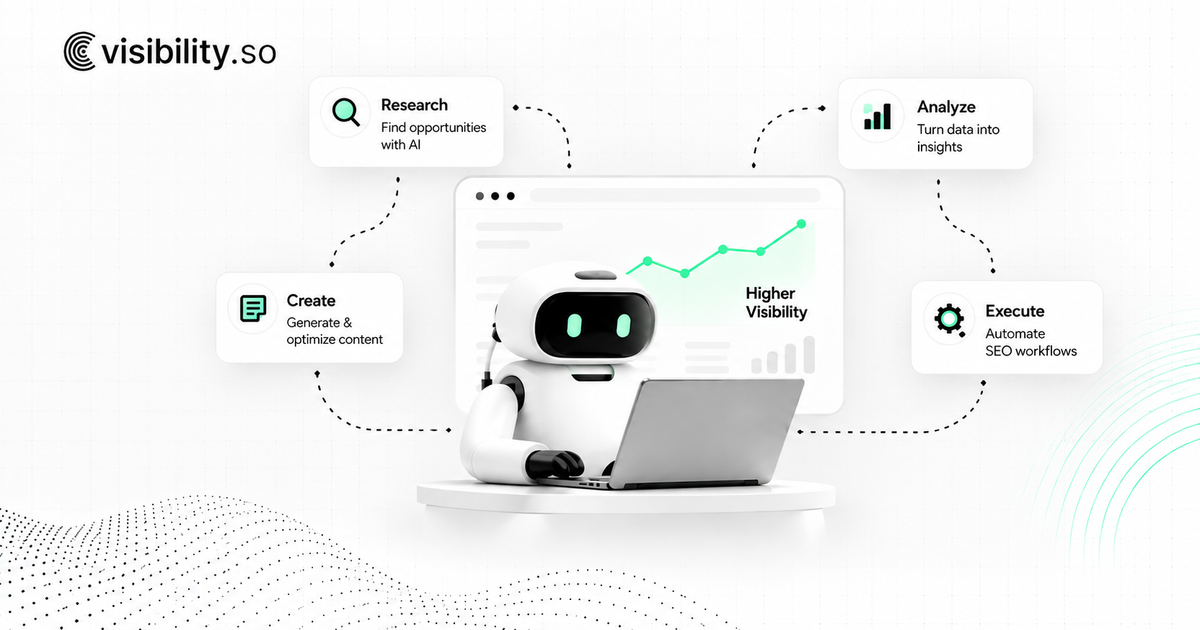
AI agents for SEO are changing how teams run search campaigns, and 2026 is the year the shift became impossible to ignore. Instead of prompting a chatbot one task at a time, a modern SEO AI agent plans and runs multi-step work on its own, researching keywords, auditing pages, drafting content, and building links. Teams that pair these agents with a human strategist inside SEO project management software are the ones scaling output without scaling headcount. This guide explains what AI agents for SEO actually are, how to use them, and what each Visibility agent can do. an AI SEO agent is not a tool you prompt. It is a teammate you brief once, and it handles the repetitive volume of SEO while your people keep the judgment calls. Below, we break down what that means in practice.
Table of Contents
- What Are AI Agents for SEO?
- Why 2026 Changed SEO Forever
- AI Agent vs. AI Tool: What's the Difference?
- How to Use AI Agents in SEO
- What SEO Agents Can Do: Every Visibility Agent
- How Visibility Compares to Popular Agentic SEO Platforms
- Top Agentic SEO Platforms in 2026 and Where Visibility Wins
- AI Agents for SEO and Marketing
- Frequently Asked Questions
What Are AI Agents for SEO?
An AI agent for SEO is software that executes a multi-step search task without waiting for you to prompt it at every stage. You give it a goal: "find our top 50 keyword gaps and draft briefs for the best 10," and the agent decides what data to pull, which steps to run, and when to surface work for your review.
The defining trait is goal-orientation, not instruction-orientation. A traditional AI SEO tool waits for a prompt and returns a single answer. An agent chains steps together: it can crawl, analyze, draft, cite sources, and ship a reviewable result in one run.
The best way to think about it is the difference between hiring a contractor for each small task and hiring a full-time teammate. The agent owns a discipline. You stay accountable for what ships.
Why AI in 2026 Changed SEO Forever
Three forces converged to make agentic SEO the default operating model this year.
Gartner predicted that traditional search engine volume will drop 25% by 2026, with search marketing losing share to AI chatbots and other virtual agents. That prediction is no longer a forecast; it is the current reality. Google put AI at the front of the results page. Google's rollout of AI Overviews (its "Supercharging Search with generative AI" work) means a generated answer now sits above the blue links for a huge share of queries. Earning a click now depends on being cited in that answer, not just ranking tenth.
The data shows the squeeze clearly. Ahrefs' analysis of 300,000 keywords from late 2023 to late 2025 found organic click-through rates for queries that trigger AI Overviews fell from 7.3% to 1.6% a 58% cut. Meanwhile, a late-2025 Microsoft study of 1,277 domains found visitors arriving from AI answers engaged roughly 11x more than typical organic referrals.
The takeaway is blunt: the volume is moving, the clicks are harder to win, and the teams holding their ground are the ones using AI agents to cover more ground with the same headcount.
What's the Difference between AI Agent vs AI tool?
People often use "AI agent" and "AI tool" interchangeably. They are not the same thing.
- An AI tool is reactive. You prompt it, it responds, and the loop ends until you prompt again. Ask a writing tool for a blog post and it returns 1,000 words. That is the whole job.
- An AI agent is proactive. Give it the same goal and it analyzes the top-ranking pages, builds a brief, drafts the article against your brand voice, optimizes it for ranking and AI citation, and hands you a reviewable output then flags decay before it costs you rankings.
A tool saves you a minute. An agent removes an entire step from your workflow. That is the difference between "faster prompting" and "a workflow that runs without you."
How to Use AI Agents in SEO
You do not need to be technical to put an SEO AI agent to work. The workflow is the same one you already use to brief a teammate.
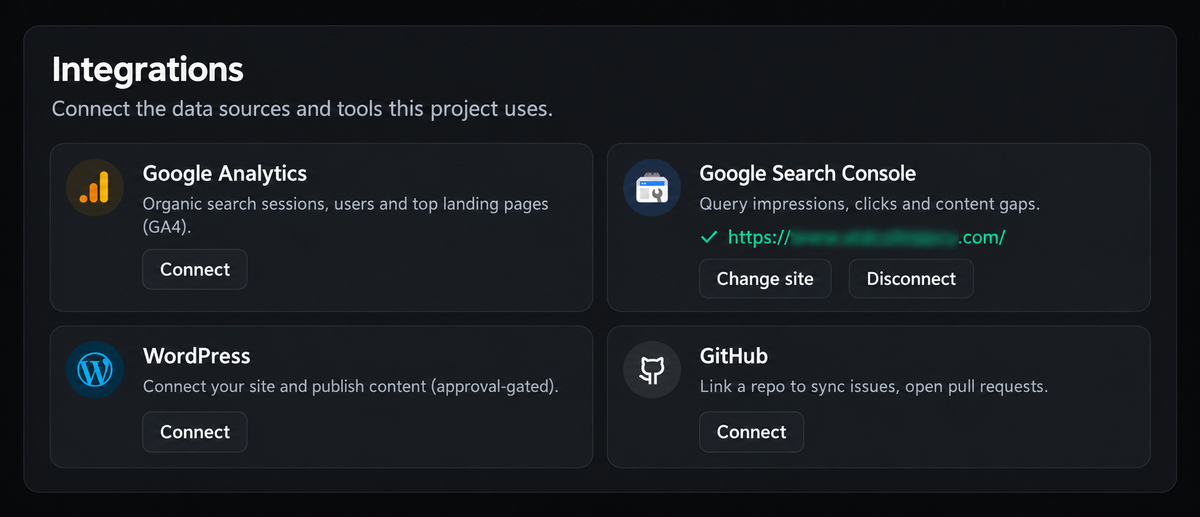
Step 1: Connect your stack. Link Search Console, Google Analytics, your CMS, and Gmail. The agent inherits access and reads your real data instead of guessing.
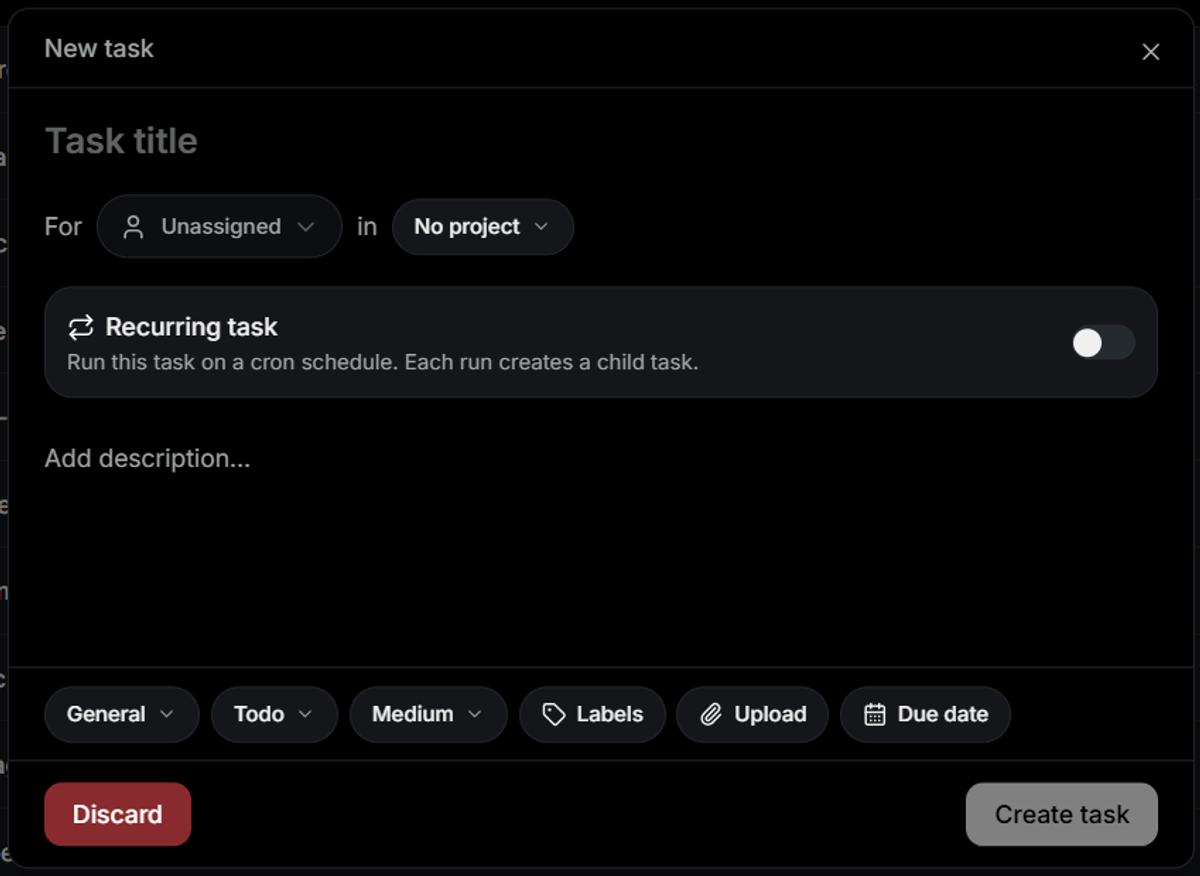
Step 2: Brief the agent. Write a task the way you would brief a human. The agent restates the goal, asks clarifying questions, and confirms scope before it starts.
Step 3: Let the agent execute. It does the deep work research, audits, drafts, prospecting, schema in minutes, citing sources and showing its reasoning end to end.
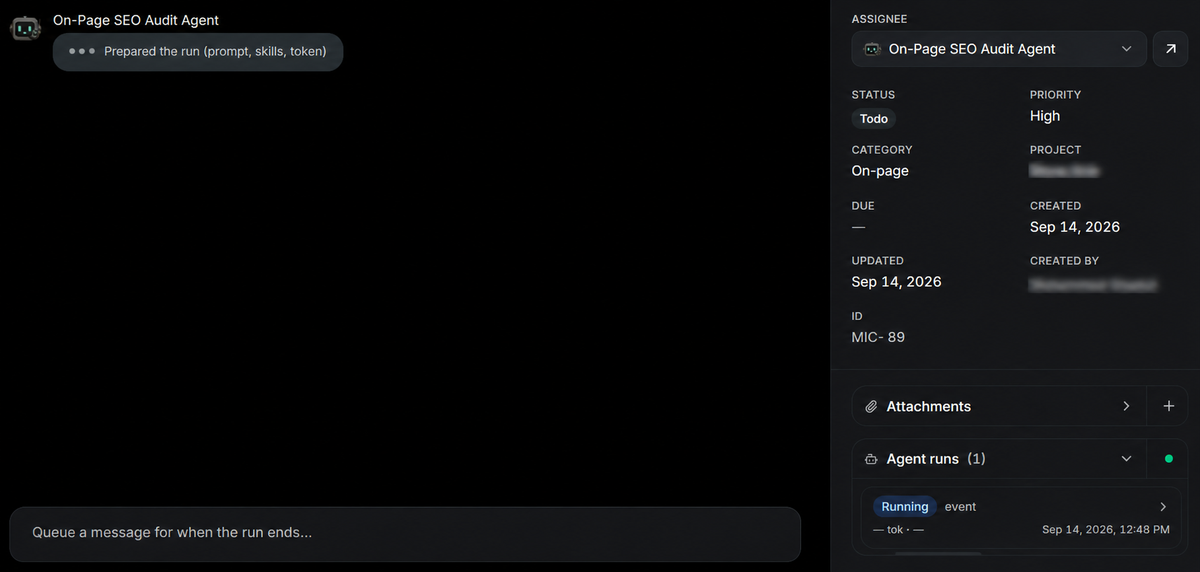
Step 4: Review and ship. You approve, edit, or send it back. Approved work flows into the same board your human team uses, so there is no separate "AI tab" to babysit.
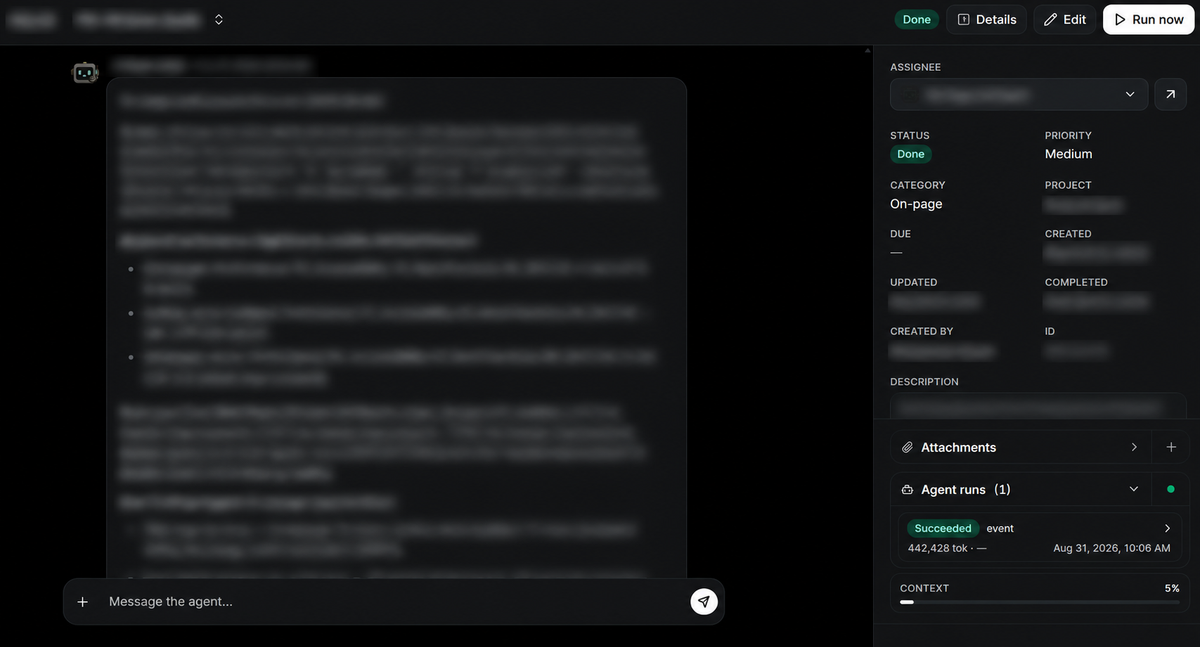
The shift in speed is real. A first content draft that used to take 3–7 days takes about 12 minutes. A content brief that cost $150–$400 in writer or analyst time is now included in your plan. And because agents run in parallel, one strategist can cover what used to require six specialists.
What SEO Agents Can Do: Best SEO Agent tools
Visibility ships a marketplace of preset SEO AI agents, each trained on one discipline, plus a custom agent you can build from scratch. Here is what each one does.
Keyword Research Agent: Discovers, scores, and clusters keywords for both traditional search and AI search. It scores every term by opportunity (volume × relevance ÷ difficulty), classifies intent, and flags which terms trigger AI answers. You get a ranked plan, not a raw keyword list.
Topic Research Agent: Compares your content against up to three competitors and finds the topics they rank for that you do not. It clusters the gaps into pillar-and-supporting-topic plans and turns each one into a task you can assign.
SEO Content Writer Agent: Brief it like a writer on your team. It researches the live SERP, drafts the full article in your brand voice, and ships it on-page optimized with title tags, internal links, and metadata.
Technical SEO Audit Agent: Runs an 8-point audit and scores your site's health from 0–100. It checks crawl and index status, Core Web Vitals, schema, HTTPS, and hreflang, backed by real data from PageSpeed, CrUX, and Search Console.
On-Page Audit Agent: Reads each page the way a search engine does. It scores titles, meta descriptions, headings, content depth, keyword targeting, internal links, image alt text, and readability, then ranks every fix by impact.
Competitor Analysis Agent: Analyzes 2–5 competitors and grades them on rankings, content, and backlinks. It scores your keyword, content, and link gaps, tracks who AI search cites, and returns a prioritized roadmap.
Backlink Builder Agent: Runs the whole link loop: it profiles your backlink footprint, finds competitor link gaps, drafts personalized outreach, and flags toxic links with a ready disavow file.
SEO Outreach Agent: Give it a domain you want a link from. It finds the right contacts, verifies their emails, sends personalized outreach from your own inbox, and follows up until they reply.
SEO Strategy Agent: Builds the full roadmap: audience-first keyword research, topical authority mapping, SEO + AEO + GEO coverage, a backlink plan, and a traffic forecast sequenced into one executable plan.
These agents work together as one team inside a single workspace. You can see a live example of how they are orchestrated on the AI SEO Agent page, and pricing is on the pricing page.
How Visibility Compares to Popular Agentic SEO Platforms
The agentic SEO market in 2026 is crowded with tools that call themselves "AI." Most are still single-purpose assistants or big suites you operate manually. Visibility is different in one specific way: it puts humans and AI agents on the same team, in the same workspace.
Platform
What it's known for
Model
Best for
Visibility
A full catalog of SEO AI agents plus human tasks in one workspace
Hybrid: humans and agents as one team
Teams that want to scale output without scaling headcount
MarketMuse
Content intelligence and topic modeling
Content planning tool
Content briefs and gap analysis
seoClarity
Enterprise SEO platform with AI automation
Managed platform
Large-scale rank tracking and reporting
Nightwatch
Rank tracking plus AI-citation tracking across ChatGPT, Claude, Gemini, and Perplexity
Tracking platform you monitor
Rank and AI-visibility tracking
Search Atlas
All-in-one SEO, AEO, ads, content, and site-health automation with the Atlas Agent
AI-assisted platform you operate
Agencies wanting one unified marketing stack
WordLift Agent
A knowledge-graph-trained SEO, content, and customer-engagement assistant
Conversational AI assistant
Brands invested in structured data
agent.a
A hub for discovering, using, and sharing AI agents
Agent directory and builder
Finding and deploying general-purpose agents
Alli AI
Technical AEO, GEO, and SEO optimization deployed at scale
Automation platform
AI-visibility fixes across many pages
Sanity
A headless CMS with agent actions and content automations
Content platform (CMS)
Content teams needing a structured foundation
Frase
A content OS for AI search: research, write, publish, and monitor
AI content platform
Content teams covering research to publish
The pattern is clear: Surfer optimizes content, Semrush and Ahrefs give you data,. Each is strong at one layer. Visibility is the only one on this list structured as multi-agent team, so instead of buying a research tool, a writing tool, an audit tool, and a link tool and stitching them together, you brief one team that covers all of them.
Where Visibility differs, in four rows:
- One team, not a toolbox
Visibility assigns work to both employees and AI agents from the same board. None of the other platforms here treats your human staff and your agents as one assignable team.
- Every discipline, one workspace
Keyword research, content, technical audits, on-page fixes, competitor analysis, backlinks, outreach, and strategy are all preset agents not five separate subscriptions.
- SEO + AEO + GEO in one workflow
Visibility optimizes for blue links, featured snippets and AI Overviews, and answers in ChatGPT, Perplexity, and Claude at the same time, where most tools still stop at the blue links.
- Reviewable output, not black-box drafts
Every agent shows its reasoning, cites sources, and ships work to your board for human approval; the judgment stays with your team.
What are some top Agentic SEO Platforms in 2026
Here is the honest shortlist of the platforms people actually compare when they shop for agentic SEO, and where Visibility comes out ahead.
Visibility, best overall for hybrid team
Visibility is the only platform in this list that runs SEO as a team sport: your employees and a catalog of nine specialist AI agents share one board, one data layer, and one review queue. Instead of buying a research tool, a writing tool, an audit tool, a link tool, and a tracking tool and stitching them together, you brief one team that covers all of them. Here are the key features none of the competitors above have, in plain bullet points:
- Humans and AI agents as one assignable team. You brief, assign, and review your employees and your AI agents from the same board. Every other platform here gives you a tool you operate or an AI tab bolted onto a suite; none treats your staff and your agents as a single team with one shared queue.
- A full catalog of nine specialist agents, plus a custom agent you build yourself. Keyword research, topic research, content writing, technical audits, on-page audits, competitor analysis, backlinks, outreach, and strategy all ship as preset specialists in one workspace , and you can build a custom agent for anything no template covers. Competitors each cover one layer (content, data, tracking, or hosting); none ships the whole team.
- SEO + AEO + GEO in one workflow. Visibility optimizes for blue links, featured snippets and AI Overviews, and answers in ChatGPT, Perplexity, and Claude at the same time. Most of this list still stops at the blue links, and the citation trackers watch AI answers without producing the work that earns them.
- Reviewable, cited output , no black boxes. Every agent shows its reasoning, cites its sources, and ships the work to your board for human approval, so the judgment stays with your people while the volume gets done. The prompt-and-pray tools return a single answer with no audit trail.
- Agents that run on your real data. Connect Search Console, Google Analytics, your CMS, and Gmail, and the agents read your actual site and campaign data instead of guessing from generic training data.
2. Nightwatch
What it is: A rank-tracking platform that now leads with "Citation Intelligence," uniting your Google rankings with your visibility in ChatGPT, Claude, Gemini, and Perplexity.
Best for: Teams that need to see how ranking shapes AI citations.
Where it falls short: It tracks and reports it does not research, draft, or build links.
3. Search Atlas
What it is: LinkGraph's all-in-one SEO, AEO, ads, content, and site-health platform, with the Atlas Agent acting as an "AI CMO" and OTTO applying technical and on-page fixes from live search data.
Best for: Agencies wanting one unified white-label marketing stack.
Where it falls short: You still operate the platform rather than briefing a team of specialist agents you approve alongside your people.
4. WordLift Agent
What it is: A conversational agent trained on a brand's own knowledge graph and proprietary SEO data, covering SEO insights, content creation, and customer engagement.
Best for: Brands already invested in structured data and knowledge graphs.
Where it falls short: It is a single assistant backlinks, outreach, and technical audits still live elsewhere.
5. agent.ai
What it is: HubSpot's hub for discovering, using, sharing, and building AI agents a directory and marketplace.
Best for: Exploring what agents can do broadly and deploying general-purpose agents.
Where it falls short: It is not an SEO team; you assemble search capability from third-party agents yourself.
6. Alli AI
What it is: An automation platform that deploys technical AEO, GEO, and SEO optimizations at scale, targeting the pages ChatGPT, Claude, and Gemini cannot see. Best for: AI-visibility fixes across many pages at once. Where it falls short: Content strategy, links, and outreach still need separate tools.
7. Sanity
What it is: A headless CMS whose content platform adds agent actions, functions, and content agents that automate publishing updating documents, finding missing translations, and triggering rebuilds.
Best for: Content teams that need a structured, agent-powered foundation to publish into.
Where it falls short: It is content infrastructure, not an SEO agent for keyword research, audits, and links live elsewhere.
8. Frase
What it is: A content operating system for AI search that audits your site, drafts content in your voice, publishes to your CMS, and uses Content Guard to watch rankings and AI mentions and write fixes when pages slip.
Best for: A full content pipeline from research to publish.
Where it falls short: Technical SEO, backlinks, and outreach still come from other tools.
Put simply: every platform on this list is great at one thing. Visibility is the only one built to be your whole SEO team humans and AI agents together which is why it earns the top slot here. See pricing or book a demo to compare for your own campaigns.
AI Agents for SEO and Marketing
Agentic SEO does not stop at rankings. The same agents serve marketing broadly because search has merged with AI assistants.
When a buyer asks ChatGPT or Perplexity "what's the best tool for X," the brands cited in the answer win the conversation. Visibility's agents handle this directly: the Keyword Research Agent flags GEO signals, the Competitor Analysis Agent tracks who AI engines cite, and the Content Writer Agent optimizes pages to earn those citations. That is why Visibility positions agentic SEO across three layers at once SEO (blue links), AEO (featured snippets and AI Overviews), and GEO (answers in ChatGPT, Perplexity, and Claude).
For marketing teams, this means one agentic workflow now covers search rankings, AI visibility, content production, and link building without running four separate toolchains. See the AI visibility solution for how this works in detail.
Final Verdict
The bottom line: AI agents for SEO are not a passing trend. They are the new operating model for search, and the teams adopting them are pulling ahead on output, cost, and AI visibility. If you want to see what an agentic SEO workflow looks like on your own campaigns, book a demo or explore the Visibility blog for more on hybrid SEO and agentic workflows.
Frequently Asked Questions
How can an AI SEO agent instantly improve your SEO?
By removing the lag between finding an issue and fixing it. A human SEO spots a gap, then schedules the work; an agent closes that loop in minutes. Concretely, a Visibility agent turns a topic gap into a scored task, a technical issue into an assigned fix, and a content brief into a full draft in about 12 minutes. The "instant" improvement is not magic it is that the work that used to sit in a backlog now ships the same day it is found.
Which AI agent is best for SEO?
No single agent is best, because SEO is a set of disciplines, not one job. The strongest setup is a small specialist team: a keyword research agent to pick targets, a content writer agent to produce pages, a technical audit agent to keep the site healthy, and a backlink and outreach agent to earn authority all coordinated in one workspace. Visibility ships these as preset agents plus a custom agent you can build for the work no template covers.
Can AI be used for SEO?
Yes, and it already is. AI is strongest at the high-volume, repetitive parts of SEO: research, audits, drafting, prospecting, and reporting. It is weakest at the judgment calls: strategy, brand voice, and final approval. The teams getting results keep a human in the loop on those calls while letting agents run the volume. That hybrid model of humans and AI agents in one team is exactly what Visibility is built for.
What are the 7 types of AI agents?
AI research commonly groups agents into seven types:
- Simple reflex agents: act only on the current input, with no memory.
- Model-based reflex agents: keep an internal model of the world to handle partial information.
- Goal-based agents: choose actions that move toward a specific goal.
- Utility-based agents: score outcomes and pick the one with the highest value.
- Learning agents: improve their behavior from feedback over time.
- Hierarchical agents: break a goal into sub-goals and layers.
- Multi-agent systems: several agents coordinate to solve a bigger problem.
Modern SEO agents sit in the last four buckets. They are goal-based and utility-based (they optimize for a target outcome), they learn from past runs, and they work as a multi-agent system which is exactly how Visibility structures its catalog: specialist agents that coordinate on one shared goal.
 Ask ChatGPT
 Ask Claude
 Ask Perplexity